

Partial knee replacement sounds smaller than total knee replacement, but for the patient, the question is usually much bigger.
“How long will the surgery take?”
“When will I walk again?”
“How many days will I need rest?”
“When can I return to normal life?”
These are practical questions, especially for patients who are managing knee pain, work responsibilities, family duties, and fear of surgery at the same time.
The good news is that partial knee replacement is usually less invasive than total knee replacement when the patient is selected correctly. Since only the damaged part of the knee is replaced and the healthy parts are preserved, recovery may be faster for many patients.
But the exact timeline depends on your age, knee condition, overall health, arthritis severity, muscle strength, surgical technique, and post-surgery rehabilitation.
Let’s understand the complete journey from surgery time to full recovery.
What Is Partial Knee Replacement?
Partial knee replacement, also called unicompartmental knee replacement, is a surgery where only the damaged compartment of the knee is replaced with an artificial implant.
The knee has three main compartments:
- Inner compartment
- Outer compartment
- Kneecap compartment
If arthritis or damage is limited to only one compartment, the surgeon may recommend partial knee replacement instead of total knee replacement.
This surgery helps preserve more natural bone, ligaments, and knee movement. That is why many suitable patients experience a more natural knee feel after recovery.
However, it is not for everyone. If arthritis has affected multiple compartments of the knee, total knee replacement may be a better option.
How Long Does Partial Knee Replacement Surgery Take?
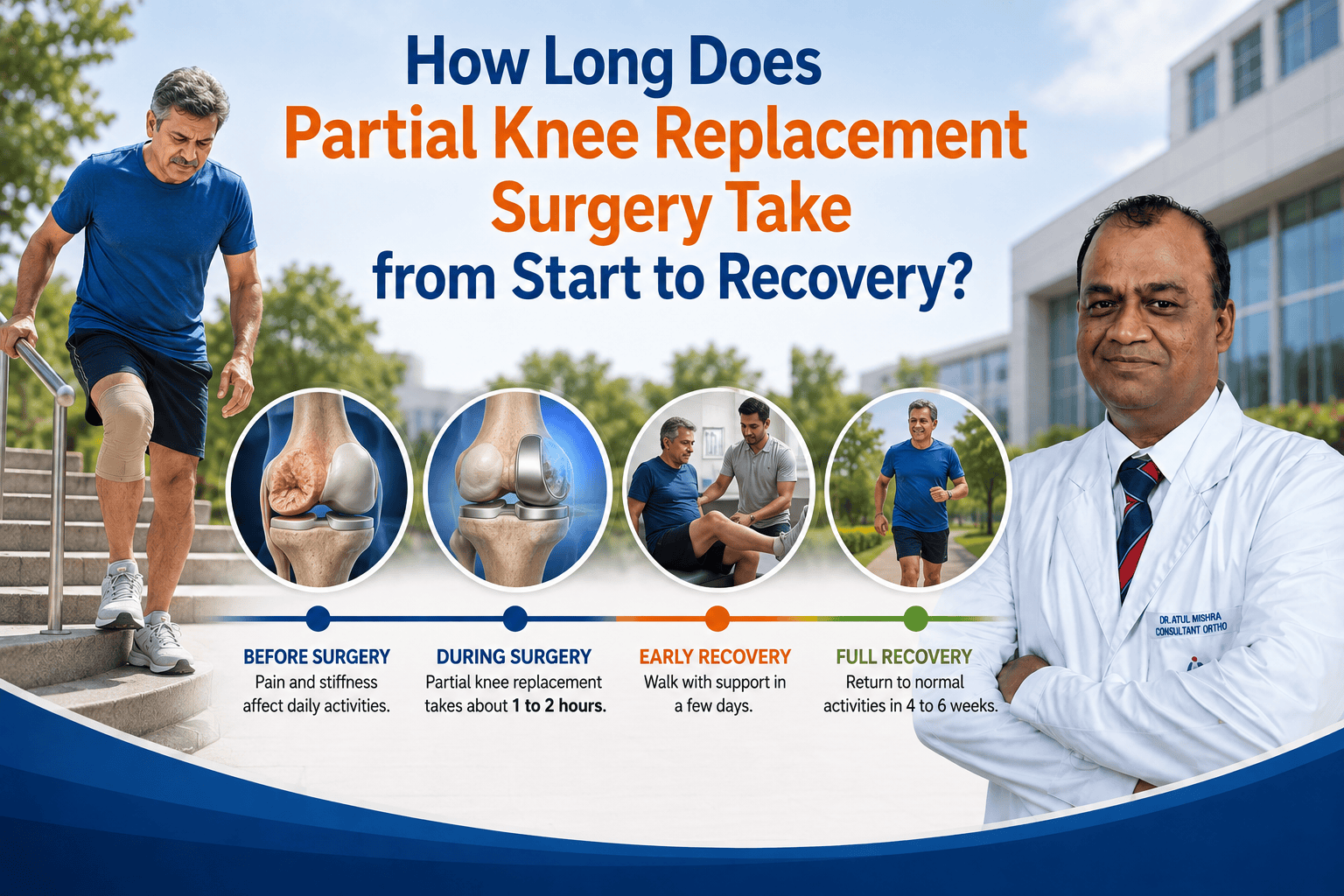
In most cases, partial knee replacement surgery takes around 1 to 2 hours.
However, the total hospital process is longer because it includes preparation before surgery and monitoring after surgery.
A typical surgery day may look like this:
Before Surgery
Before the operation starts, the medical team checks your vitals, reviews your reports, prepares the surgical area, and gives anaesthesia. This preparation may take some time before the actual surgery begins.
During Surgery
The surgeon removes the damaged cartilage and bone from the affected compartment of the knee. The healthy areas are preserved. Then the implant is placed carefully to restore joint movement and alignment.
After Surgery
Once the surgery is complete, you are moved to a recovery area where doctors and nurses monitor your blood pressure, pain level, movement, and overall condition.
So, while the actual operation may take around 1 to 2 hours, the complete hospital process on the day of surgery takes longer.
Can You Walk After Partial Knee Replacement?
Yes, many patients are encouraged to stand and walk with support soon after surgery, depending on their condition and the surgeon’s advice.
Walking usually begins with the help of a walker, crutches, or physiotherapist. The goal is not to rush the knee, but to activate movement safely.
Early walking helps improve blood circulation, reduce stiffness, and support recovery. But the walking plan must be guided by the orthopaedic surgeon and physiotherapy team.
How Many Days Do You Need to Stay in the Hospital?
Hospital stay after partial knee replacement varies from patient to patient.
Some patients may go home within 1 to 3 days, depending on their health, pain control, walking ability, and home support. In some cases, the stay may be longer if the patient has other medical conditions or needs additional monitoring.
Before discharge, doctors usually check whether the patient can walk with support, manage basic movements, and understand home care instructions.
Partial Knee Replacement Recovery Timeline
Recovery does not happen in one day. It happens in stages. Here is a general timeline patients can expect.
First 24 to 48 Hours After Surgery
This is the immediate recovery phase.
You may experience pain, swelling, tightness, and difficulty moving the knee. These symptoms are normal after surgery and are managed with medicines, icing, elevation, and supervised movement.
During this stage, the medical team focuses on:
- Pain control
- Early walking support
- Knee movement
- Preventing stiffness
- Monitoring wound condition
Physiotherapy may begin early, depending on your surgeon’s advice.
First Week After Surgery
During the first week, the focus is on safe movement and swelling control.
You may be able to walk short distances with support. Some patients can manage basic household movement, but rest is still very important.
You should avoid sudden twisting, sitting on the floor, climbing too many stairs, or putting unnecessary pressure on the operated knee.
The first week is not about testing your limits. It is about healing correctly.
2 to 6 Weeks After Surgery
This is one of the most important recovery phases.
Many patients start feeling more confident while walking. Pain and swelling usually reduce gradually. Knee bending improves with physiotherapy. Daily activities become easier.
During this stage, patients often work on:
- Improving knee range of motion
- Strengthening thigh muscles
- Walking with better balance
- Reducing dependence on support
- Returning to light daily activities
Some patients may return to desk work within a few weeks, depending on pain, mobility, and the nature of their job.
6 Weeks to 3 Months After Surgery
By this time, many patients experience a noticeable improvement in walking, comfort, and confidence.
You may be able to do more regular activities, but high-impact activities should still be avoided unless your surgeon allows them.
This phase is important for strengthening the knee and improving long-term function. Physiotherapy and home exercises should not be ignored just because the pain has reduced.
A common mistake patients make is stopping rehab too early. Recovery is not only about pain relief. It is also about strength, balance, flexibility, and safe movement.
3 to 6 Months After Surgery
Most patients continue to improve during this period.
Walking becomes easier. Stiffness reduces. The knee starts feeling more natural. Many patients return to a more active routine, depending on their health and recovery progress.
However, some mild swelling or discomfort may still happen after long walks or excess activity. This does not always mean something is wrong, but it should be discussed with your doctor if it is persistent or severe.
Full Recovery After Partial Knee Replacement
Many patients recover enough for normal daily activities within a few weeks, but complete recovery may take several months.
In some cases, the final result of knee replacement continues to improve for up to 6 to 12 months.
The recovery timeline depends on:
- Age
- Weight
- Muscle strength
- Diabetes or other health conditions
- Bone quality
- Physiotherapy consistency
- Surgical accuracy
- Implant positioning
- Patient motivation
- Condition of the remaining knee compartments
So instead of comparing your recovery with someone else’s, it is better to follow your surgeon’s recovery plan.
Is Partial Knee Replacement Recovery Faster Than Total Knee Replacement?
Usually, yes.
Partial knee replacement may allow faster recovery because only one damaged part of the knee is treated. The healthy parts of the knee are preserved, and the surgery may involve less tissue disruption compared to total knee replacement.
Patients may experience:
- Smaller incision
- Less blood loss
- Faster early mobility
- More natural knee movement
- Shorter hospital stays in selected cases
But this benefit applies only when the patient is the right candidate. If partial knee replacement is done in the wrong patient, the results may not be ideal.
That is why proper diagnosis, X-rays, clinical examination, and surgeon experience matter.
When Can You Climb Stairs After Partial Knee Replacement?
Many patients can start stair climbing with support during early recovery, but it must be done carefully.
Initially, you may be taught a safe pattern by the physiotherapist. Usually, the stronger leg leads while going up, and the operated leg leads while coming down.
You should not climb stairs repeatedly in the first few days unless advised.
When Can You Drive After Partial Knee Replacement?
Driving depends on which knee was operated on, your pain level, muscle control, and whether you are taking strong pain medicines.
Some patients may return to driving after a few weeks, but only after surgeon approval. You should be able to bend the knee comfortably, control the vehicle safely, and react quickly in traffic.
Never restart driving without medical clearance.
How to Recover Faster After Partial Knee Replacement
Recovery is not only controlled by surgery. Your habits after surgery matter a lot.
To support better recovery:
- Follow your physiotherapy schedule
- Take medicines as prescribed
- Keep the wound clean and dry
- Avoid unnecessary strain
- Do not skip follow-up visits
- Maintain a healthy weight
- Eat protein-rich and nutritious food
- Avoid smoking
- Control diabetes if you have it
- Report unusual pain, fever, redness, or swelling
The best recovery happens when surgery, rehabilitation, and patient discipline work together.
When Should You Contact Your Doctor?
You should contact your orthopaedic surgeon if you notice:
- Fever
- Severe pain that does not improve
- Excessive swelling
- Redness around the wound
- Pus or discharge
- Sudden calf pain
- Chest pain or breathing difficulty
- Inability to move the knee
- Sudden instability
Do not ignore warning signs after surgery.
Why Choose ASIC Clinic for Partial Knee Replacement?
At ASIC Clinic, partial knee replacement is planned only after carefully evaluating the patient’s knee condition, arthritis pattern, age, activity level, and long-term mobility goals.
The focus is not just on replacing the damaged part of the knee. The focus is on helping the patient return to better movement, reduced pain, and improved quality of life.
With expert orthopaedic evaluation and patient-specific treatment planning, ASIC Clinic helps patients understand whether partial knee replacement is truly the right option for them.
Final Thoughts
Partial knee replacement surgery usually takes around 1 to 2 hours, but recovery is a gradual journey.
Many patients begin walking with support soon after surgery and return to daily activities within a few weeks. However, full recovery can take several months, depending on the patient’s health, knee condition, and rehabilitation.
The most important thing is choosing the right surgery for the right patient.
If your knee pain is limited to one side of the knee and medicines, injections, or physiotherapy are no longer helping, consult an experienced orthopaedic surgeon to know whether partial knee replacement is suitable for you.
FAQs
Partial knee replacement surgery usually takes around 1 to 2 hours. However, the total hospital process includes pre-surgery preparation and post-surgery monitoring.
Some pain and swelling are expected after surgery, but they are managed with medicines, icing, rest, and physiotherapy.
Many patients are encouraged to walk with support soon after surgery, depending on their condition and surgeon’s advice.
Many patients recover enough for daily activities within a few weeks, but complete recovery may take several months.
Partial knee replacement is better only for selected patients whose arthritis is limited to one compartment of the knee. If the whole knee is damaged, total knee replacement may be more suitable.
Patients with desk jobs may return within a few weeks, while physically demanding jobs may require more time. Your surgeon will guide you based on your recovery.