

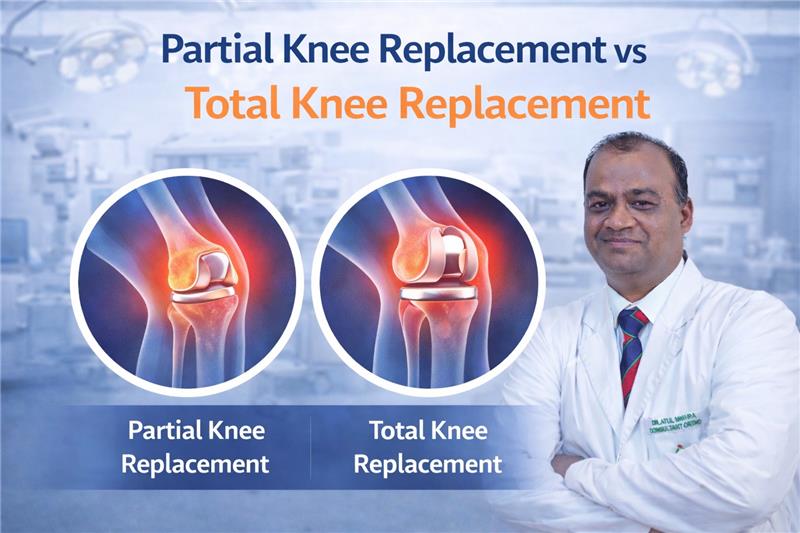
If you are suffering from long-term knee pain and your doctor has suggested Knee Replacement Surgery, one important question may come to your mind: Should you go for Partial Knee Replacement Surgery or Total Knee Replacement Surgery?
The answer depends on how much of your knee is damaged. In simple words, Partial Knee Replacement Surgery is usually done when arthritis or damage is limited to only one part of the knee, while Total Knee Replacement Surgery is done when the whole knee joint is badly affected.
This blog will help you understand the difference in a very simple way, so you can make a better decision with your surgeon.
What is Knee Replacement Surgery?
Knee Replacement Surgery is a procedure in which the damaged parts of the knee joint are replaced with artificial parts made of metal and plastic. It is usually recommended when pain, stiffness, and difficulty in walking start affecting daily life, and medicines, physiotherapy, injections, or lifestyle changes are no longer giving enough relief.
The main goal of Knee Replacement Surgery is to reduce pain, improve movement, and help the patient return to normal daily activities.
What is Partial Knee Replacement Surgery?
Partial Knee Replacement Surgery is done when only one compartment or one section of the knee is damaged. In this surgery, only the affected portion is replaced, while the healthy bone, cartilage, and ligaments in the rest of the knee are preserved. AAOS describes it as an alternative to total knee replacement for patients whose disease is limited to one area of the knee.
Because less of the knee is changed, Partial Knee Replacement Surgery is usually a smaller procedure. The cut is smaller, less bone is removed, and the recovery may be quicker for the right patient.
What is Total Knee Replacement Surgery?
Total Knee Replacement Surgery is done when arthritis or damage affects most or all parts of the knee joint. In this surgery, the surgeon resurfaces the damaged ends of the thighbone and shinbone, and sometimes the kneecap area as well, then places the artificial implant.
This option is more suitable when knee damage is widespread and a partial procedure will not give enough long-term benefit.
Partial Knee Replacement Surgery vs Total Knee Replacement Surgery
Let us compare both options in simple terms.
1. Amount of Knee Damage
This is the biggest difference. Partial Knee Replacement Surgery is for people whose arthritis is limited to one part of the knee. Total Knee Replacement Surgery is for people whose knee damage is more extensive. (Mayo Clinic)
So, not every patient is a candidate for partial replacement. Your X-rays, scans, symptoms, and physical examination help decide this.
2. Size of Surgery
Partial Knee Replacement Surgery is generally less invasive because only one part of the joint is treated. This means the surgery is smaller compared to Total Knee Replacement Surgery.
Total Knee Replacement Surgery is a larger procedure because the full joint surface is being replaced. It is often the better choice when damage is spread throughout the knee.
3. Recovery Time
One of the benefits of Partial Knee Replacement Surgery is that recovery can be faster. Mayo Clinic notes that eligible patients may recover in about half the time compared with total knee replacement recovery, and NHS also says recovery after a partial replacement should be shorter.
In Total Knee Replacement Surgery, recovery can take longer because the surgery is bigger and more tissue is involved. Still, many patients do very well after proper rehabilitation and physiotherapy.
4. Bone and Tissue Preservation
With Partial Knee Replacement Surgery, more of your natural knee is preserved. This includes healthy bone and, in many cases, key ligaments. This can help the knee feel more natural after surgery for the right patient.
With Total Knee Replacement Surgery, more bone and joint surface are replaced because the disease is more widespread.
5. Suitability
This is very important. Partial Knee Replacement Surgery is not automatically better just because it is smaller. It is only better if the disease is limited to one area and the patient is the right candidate. AAOS and Mayo Clinic both make it clear that patient selection is very important.
If arthritis has spread across the knee, Total Knee Replacement Surgery is usually the better and more dependable option.
6. Hospital Stay and Return to Routine
AAOS notes that partial replacement may mean less time in the hospital compared with total replacement. Some patients also return to desk work and light routine faster after a partial procedure.
However, recovery is different for every patient. Age, body weight, general health, fitness, and commitment to physiotherapy all affect the outcome after any Knee Replacement Surgery.
What is Robotic Partial Knee Replacement?
Robotic Partial Knee Replacement is an advanced form of Partial Knee Replacement Surgery where robotic-arm technology helps the surgeon plan and perform the surgery with greater precision. The surgeon remains fully in control, while the robotic system provides guidance during the procedure. Mayo Clinic states that robotic-arm-assisted technology allows surgeons to do partial knee replacements more precisely and is also used for partial and total knee replacements.
For some patients, Robotic Partial Knee Replacement may improve implant positioning and surgical accuracy. But just like any other surgery, the final result still depends on the patient’s condition and the surgeon’s expertise.
Which is Better?
There is no one answer for everyone.
If only one part of your knee is damaged, Partial Knee Replacement Surgery may be a very good option because it is smaller, preserves more of your natural knee, and may allow faster recovery.
If the whole knee is damaged, Total Knee Replacement Surgery is usually the better choice because it treats the full joint and can provide more complete pain relief for widespread arthritis.
So the better option is not based on trend or technology alone. It is based on your knee condition.
Final Thoughts
Both Partial Knee Replacement Surgery and Total Knee Replacement Surgery are effective treatments for knee arthritis and long-term knee pain. The right surgery depends on how much of the knee is damaged, your symptoms, your age, your activity level, and your surgeon’s recommendation.
If you are the right candidate, Partial Knee Replacement Surgery or even Robotic Partial Knee Replacement may offer a smaller surgery and faster recovery. But if the damage is widespread, Total Knee Replacement Surgery may give better long-term relief.
The smartest step is to get a proper evaluation and discuss all options with an experienced knee replacement surgeon.
FAQ’s
The main difference is the amount of knee damage being treated. Partial replacement treats only one damaged part of the knee, while total replacement treats the whole joint.
It can be better only for patients whose arthritis is limited to one area of the knee. It is not better for everyone.
Yes, recovery is often shorter after partial replacement compared with total replacement, especially in suitable patients.
Robotic Partial Knee Replacement is a partial knee replacement done with robotic-arm assistance to help improve planning and precision. The surgeon still performs the operation.
A person with severe arthritis or damage affecting most or all parts of the knee may be a better candidate for Total Knee Replacement Surgery.
Yes. Your orthopaedic surgeon will decide based on your symptoms, examination, X-rays, scans, and the extent of knee damage.