

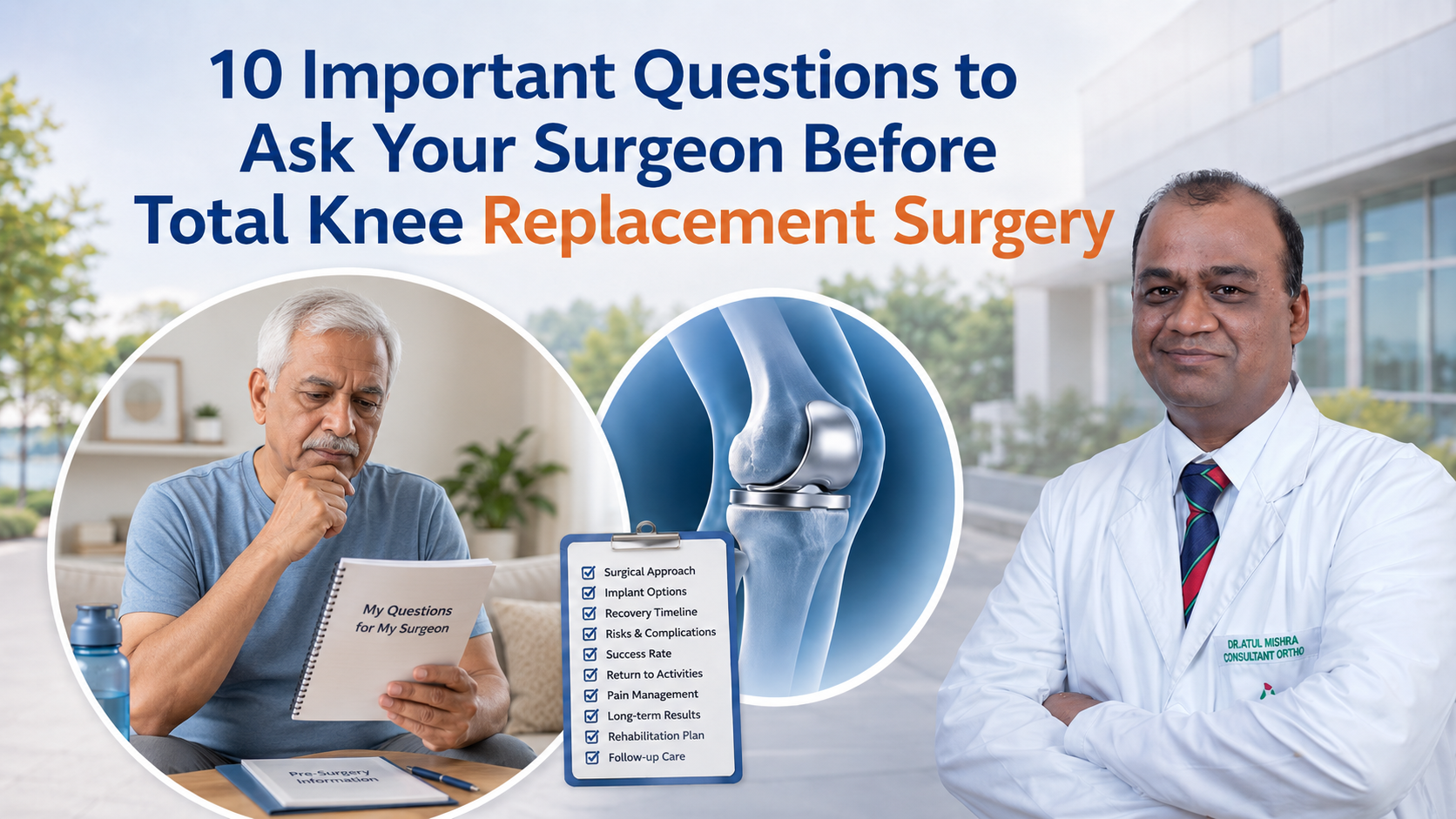
Total knee replacement surgery can be life-changing for people living with severe knee pain, stiffness, arthritis, or difficulty walking. But before you decide to go ahead with surgery, the most important thing is clarity.
Many patients focus only on one question: “Do I need knee replacement?”
But the better question is: “Do I fully understand what will happen before, during, and after surgery?”
A total knee replacement is not just a surgical procedure. It is a complete treatment journey that includes diagnosis, planning, surgery, rehabilitation, recovery, and long-term care. The more informed you are before surgery, the more confident you feel during the process.
Here are 10 important questions every patient should ask their surgeon before total knee replacement surgery.
1. Do I Really Need Total Knee Replacement Surgery?
This should be your first question.
Not every knee pain case requires knee replacement. Sometimes, pain can be managed with medicines, physiotherapy, lifestyle changes, injections, or other non-surgical treatments. Total knee replacement is usually considered when the knee joint is badly damaged and daily activities like walking, climbing stairs, sitting, or standing become difficult.
Ask your surgeon:
“Is my knee condition severe enough for total knee replacement, or do I still have non-surgical options?”
This helps you understand whether surgery is genuinely required or if other treatments can still help.
2. Why Are You Recommending Total Knee Replacement Instead of Partial Knee Replacement?
Many patients are not aware that there are different types of knee replacement procedures. In some cases, only one part of the knee is damaged. In such cases, partial knee replacement may be considered. But if arthritis or joint damage has affected multiple compartments of the knee, total knee replacement may be the better option.
Ask your surgeon:
“Is my entire knee joint damaged, or only one part of it?”
This question helps you understand why total knee replacement is being recommended for your condition.
3. What Type of Implant Will Be Used?
The implant used in knee replacement plays an important role in movement, stability, and long-term performance. Different implants may be selected based on your age, bone quality, weight, activity level, knee deformity, and medical condition.
Ask your surgeon:
“Which knee implant will you use for me, and why is it suitable for my case?”
A good surgeon will explain the implant choice in simple terms and help you understand how it matches your body and lifestyle.
4. How Experienced Are You in Performing Total Knee Replacement Surgery?
Surgeon experiences matter. Total knee replacement requires precision, planning, alignment, and careful handling of the surrounding tissues. The outcome depends not only on the implant but also on the surgical technique and decision-making.
Ask your surgeon:
“How many total knee replacement surgeries do you perform regularly?”
This is not an uncomfortable question. It is a practical question. You are trusting your mobility and quality of life to the surgeon, so you have the right to know their experience.
5. What Are the Risks and Possible Complications?
Every surgery has some risks. In total knee replacement, possible complications may include infection, blood clots, stiffness, implant loosening, persistent pain, wound complications, or the need for future revision surgery.
Ask your surgeon:
“What complications should I be aware of in my case?”
This question is important because every patient has a different risk profile. Diabetes, obesity, heart disease, smoking, weak bones, previous surgery, or infection history can affect surgical risk and recovery.
6. How Long Will Recovery Take?
Recovery after total knee replacement is gradual. Some patients start walking with support within a short time after surgery, but full recovery takes longer. Physiotherapy, exercise, wound care, pain control, and regular follow-ups are all part of the healing process.
Ask your surgeon:
“When can I walk, climb stairs, drive, return to work, and resume daily activities?”
This gives you realistic expectations. It also helps you plan family support, work leave, travel, and home arrangements before surgery.
7. What Will Pain Management Look Like After Surgery?
Pain after knee replacement is normal, but it should be managed properly. Good pain control helps you move early, participate in physiotherapy, sleep better, and recover with more confidence.
Ask your surgeon:
“How will my pain be managed after surgery?”
Also ask about medicines, ice therapy, physiotherapy, and what level of pain is considered normal during recovery. Patients should not avoid movement due to fear of pain, but they should also not ignore unusual pain.
8. What Role Will Physiotherapy Play in My Recovery?
Physiotherapy is one of the most important parts of total knee replacement recovery. Surgery corrects the damaged joint, but physiotherapy helps restore movement, strength, balance, and confidence.
Ask your surgeon:
“When will physiotherapy start, and how long will I need it?”
You should also ask which exercises are safe, how often you should do them, and what movements should be avoided in the early recovery phase.
A successful knee replacement is not only about surgery. It is also about how seriously you follow rehabilitation.
9. How Long Will the Knee Implant Last?
Modern knee implants are designed to last for many years, but no implant lasts forever in every patient. Implant life depends on several factors, including body weight, activity level, bone quality, implant positioning, infection risk, and long-term care.
Ask your surgeon:
“How long can I expect my knee implant to last?”
Also ask what you can do to protect the implant. Maintaining a healthy weight, avoiding high-impact activities, following exercise advice, and attending follow-up visits can help improve long-term outcomes.
10. What Happens If the Knee Replacement Fails in the Future?
This is a question many patients avoid, but it is important.
In some cases, a knee replacement may need revision surgery later due to implant loosening, infection, instability, wear, stiffness, or injury. Revision knee replacement is usually more complex than first-time knee replacement, so proper planning and expert care matter.
Ask your surgeon:
“If my knee replacement fails in the future, what are my options?”
This does not mean your surgery will fail. It simply means you are thinking long term and understanding the complete journey.
Why Asking the Right Questions Matters
A well-informed patient is usually more confident, better prepared, and more active in recovery. Asking questions does not mean you doubt your surgeon. It means you want to understand your treatment properly.
Before total knee replacement surgery, you should know:
- Why surgery is needed
- Which implant will be used
- What risks are involved
- How recovery will happen
- What results you can realistically expect
- How to protect your new knee in the long run
The goal of total knee replacement is not just pain relief. The goal is to help you return to better movement, better function, and a more comfortable life.
Consult Dr. Atul Mishra for Total Knee Replacement Surgery in Delhi
If you are suffering from severe knee pain, arthritis, stiffness, or difficulty walking, consult Dr. Atul Mishra at ASIC Clinic for expert evaluation and advanced knee replacement guidance.
At ASIC Clinic, patients receive proper diagnosis, surgical planning, treatment explanation, and recovery guidance so they can make informed decisions about their knee health.
Book a consultation with Dr. Atul Mishra and understand whether total knee replacement is the right option for you.
FAQs
You may consider total knee replacement when knee pain, stiffness, or arthritis severely affects walking, stair climbing, sleep, and daily activities, and non-surgical treatments are no longer helping.
Total knee replacement is better when damage affects most or all parts of the knee joint. Partial knee replacement may be suitable only when damage is limited to one compartment.
Some pain is expected after surgery, especially during the early recovery phase. However, pain is usually managed with medicines, physiotherapy, and proper post-operative care.
Many patients start walking with support soon after surgery, depending on their health, surgical condition, and doctor’s advice. Full recovery takes time and requires physiotherapy.
Yes, although many knee replacements work well for years, failure can happen due to infection, loosening, wear, instability, stiffness, or injury. In such cases, revision knee replacement may be needed.