

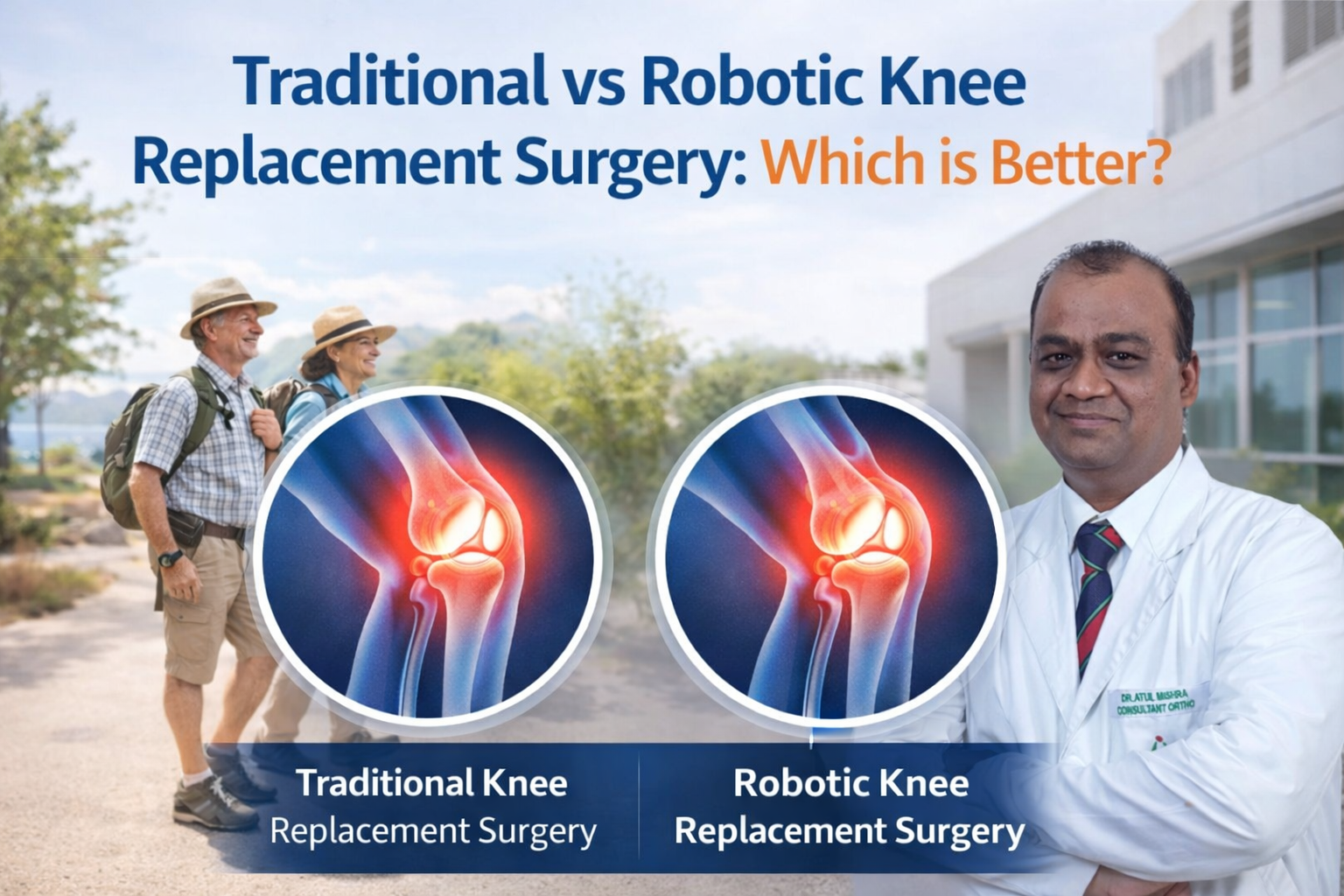
If you or a family member is planning a Knee Replacement Surgery, one common question comes up very quickly: Should you choose Traditional Knee Replacement Surgery or Robotic Knee Replacement Surgery?
The simple answer is this: both can give very good results when done by an experienced surgeon. The better option depends on your knee condition, your bone structure, your surgeon’s experience, and the technology available at the hospital. Robotic surgery is not a robot doing the operation alone. It is still the surgeon performing the surgery, with robotic guidance helping improve planning and precision.
What is Knee Replacement Surgery?
Knee Replacement Surgery is a procedure in which the damaged parts of the knee joint are removed and replaced with artificial components. It is usually advised when severe arthritis, long-term pain, stiffness, and difficulty in walking start affecting daily life. The aim is to reduce pain, improve movement, and help the patient return to normal activities.
What is Traditional Knee Replacement Surgery?
In Traditional Knee Replacement Surgery, the surgeon uses standard surgical instruments to remove damaged bone and cartilage and place the implant in the correct position. This method has been used for many years and has helped a large number of patients live with less pain and better mobility.
Traditional surgery is well established, trusted, and widely available. It remains an excellent option, especially when it is performed by a skilled orthopaedic surgeon. Many successful knee replacements done today are still done using this method.
What is Robotic Knee Replacement Surgery?
Robotic Knee Replacement Surgery uses advanced technology to help the surgeon plan and perform the operation with more precision. Before or during the surgery, the system creates a detailed view of the patient’s knee. This helps the surgeon make a more personalised plan based on the patient’s anatomy. During the operation, the robotic system provides guidance and feedback, helping the surgeon position the implant more accurately.
This is important to understand: in Robotic Knee Replacement Surgery, the surgeon is still fully in control. The machine does not replace the doctor. It supports the doctor with better accuracy and planning.
Traditional Knee Replacement Surgery vs Robotic Knee Replacement Surgery
Let us compare both in simple terms.
1. Precision
One of the biggest advantages of Robotic Knee Replacement Surgery is precision. The robotic system helps the surgeon place the implant in a planned position that matches the patient’s body more closely. Accurate implant placement may help with knee balance, alignment, and smooth movement.
In Traditional Knee Replacement Surgery, implant placement depends mainly on the surgeon’s manual technique and experience. A highly experienced surgeon can still achieve excellent results.
2. Personalised Planning
Robotic Knee Replacement Surgery allows a more individualised plan because every patient’s knee is slightly different. Some systems use imaging and digital planning to map the knee before the implant is placed. This can be useful in complex cases.
Traditional Knee Replacement Surgery is also planned carefully, but robotic systems offer an extra layer of data and control.
3. Soft Tissue Protection
Robotic assistance may help the surgeon remove only the required amount of bone and cartilage and reduce unnecessary damage to nearby tissues. This may improve knee balance and early comfort after surgery.
In Traditional Knee Replacement Surgery, this depends more on manual judgement and surgical experience.
4. Recovery
Some studies and hospital reports suggest that Robotic Knee Replacement Surgery may help reduce pain and support faster early recovery in some patients. However, recovery also depends on age, fitness, physiotherapy, pain control, and how serious the knee damage was before surgery.
That means not every patient will recover faster just because robotics were used. Good rehabilitation still matters a lot after both types of Knee Replacement Surgery.
5. Long-Term Outcome
Both Traditional Knee Replacement Surgery and Robotic Knee Replacement Surgery can offer long-lasting pain relief and functional improvement. Robotic technology is designed to improve alignment and implant positioning, which may support better function and possible implant longevity, but long-term outcomes still depend on many factors, including implant type, surgical skill, patient weight, activity level, and follow-up care.
6. Availability and Cost
Traditional Knee Replacement Surgery is more widely available and may be more affordable in many hospitals.
Robotic Knee Replacement Surgery may cost more because of the technology involved, and it may not be available everywhere. So for many patients, the real comparison is not just medical. It is also practical and financial.
Which One is Better?
When people ask, “Which is better, Traditional Knee Replacement Surgery or Robotic Knee Replacement Surgery?” the most honest answer is:
Robotic surgery may offer better precision, but that does not automatically make it the best choice for every patient.
If the hospital has good robotic technology and the surgeon is well-trained in using it, Robotic Knee Replacement Surgery can be a very strong option. It may help in achieving more accurate alignment and a more customised operation.
But if you have an expert knee replacement surgeon who performs excellent Traditional Knee Replacement Surgery, you can still expect very good results. In many cases, the surgeon’s skill matters more than the machine.
Who May Benefit More from Robotic Knee Replacement Surgery?
Robotic Knee Replacement Surgery may be especially useful for:
- Patients who want a more personalised surgical plan
- Patients with complex knee anatomy
- Patients where accurate implant positioning is very important
- Patients looking for advanced technology-assisted treatment
Still, the final decision should be made after a clinical examination, X-rays, and discussion with your orthopaedic surgeon.
Questions You Should Ask Your Surgeon
Before choosing any Knee Replacement Surgery, ask:
- Am I a suitable candidate for robotic surgery?
- How many robotic and traditional knee replacements have you performed?
- What are the expected benefits in my case?
- What will recovery look like?
- What is the cost difference?
These questions can help you make a smarter and more confident decision.
Final Thoughts
Both Traditional Knee Replacement Surgery and Robotic Knee Replacement Surgery are effective options for treating severe knee pain and arthritis. Robotic surgery brings better planning, more precision, and a personalised approach. Traditional surgery remains reliable, proven, and highly successful in experienced hands.
So, which is better?
For some patients, Robotic Knee Replacement Surgery may be the better choice because of improved accuracy and planning. For others, Traditional Knee Replacement Surgery may be just as effective, especially when done by a highly skilled surgeon.
The best choice is not only about technology. It is about choosing the right surgeon, the right hospital, and the right treatment plan for your knee.
FAQ’s
Both are generally safe when done by a qualified orthopaedic surgeon. Robotic surgery may offer more precision, but safety also depends on the surgeon’s skill, hospital setup, and patient health.
No. In Robotic Knee Replacement Surgery, the surgeon performs the surgery. The robotic system only assists with planning and guidance.
Some patients may feel less pain and recover faster in the early phase, but recovery is different for every person. Physiotherapy and overall health also play a major role.
No. Traditional Knee Replacement Surgery is still widely used and gives excellent results when performed by experienced surgeons.
In many hospitals, yes. The use of advanced technology can increase the overall cost.
Both can provide long-term relief. Robotic surgery may improve implant positioning and alignment, but long-term success depends on many factors, not just the technology used.