
Best Robotic Hip Replacement Surgeon in Delhi NCR — Dr. Atul Mishra
If you have joint pain that isn't going away with medicines or physiotherapy, your doctor may have already mentioned hip replacement. What's changed in the last few years is how that surgery is done. Robotic-assisted hip replacement uses a robotic arm, guided entirely by the surgeon, to plan and place the implant with a level of accuracy that's difficult to match by hand alone. Dr. Atul Mishra has been offering robotic hip replacement surgery in Delhi NCR for several years now and is widely regarded as one of the best robotic hip replacement surgeons in the region, with over 1,000 joint replacements performed every year.
If you're researching a robotic hip replacement surgeon in Delhi NCR, this page walks you through what the surgery actually involves, who it's suitable for, what it costs, and what recovery looks like — so you can have an informed conversation at your first consultation.
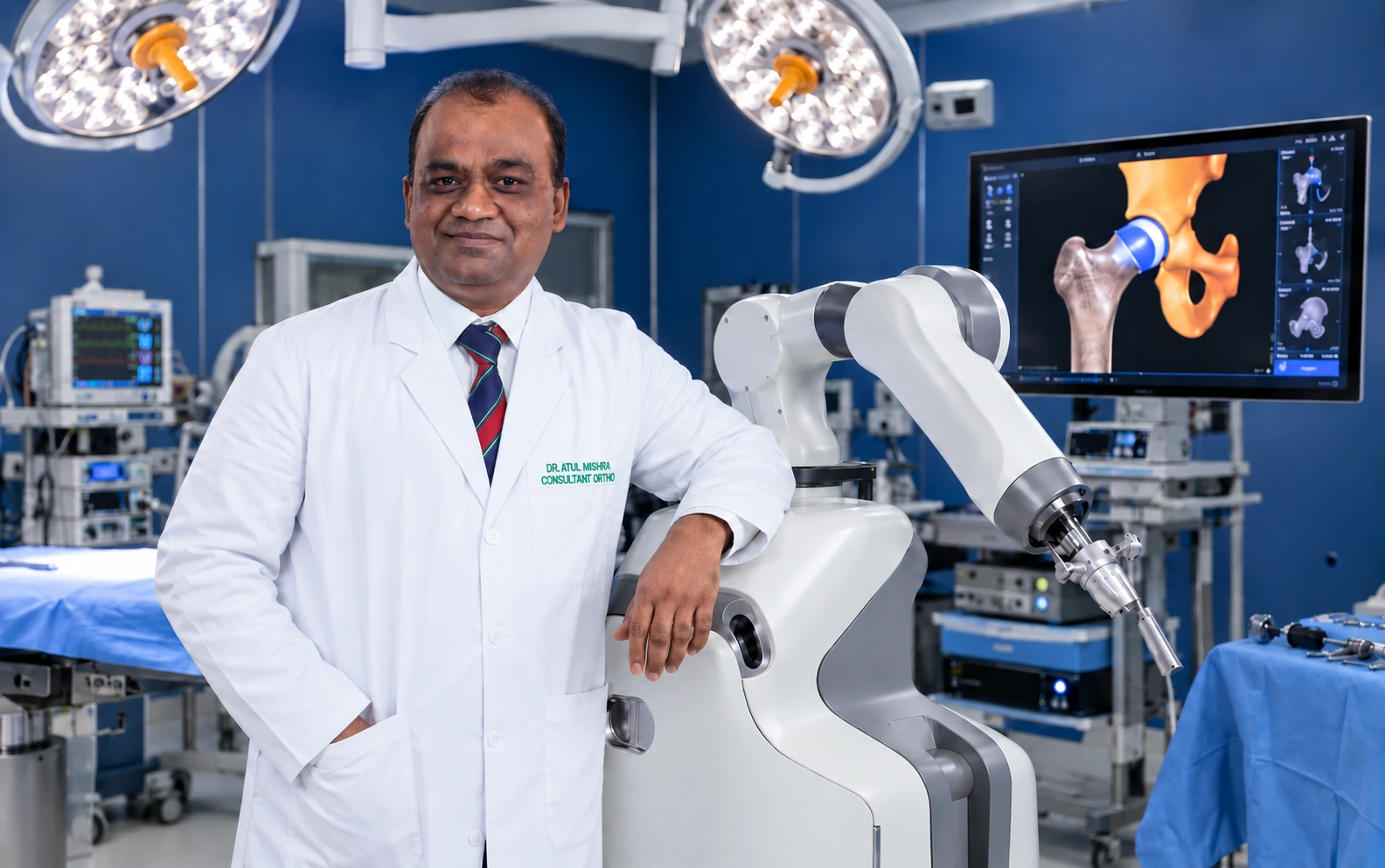
What Is Robotic Hip Replacement Surgery?
Robotic hip replacement is a form of total hip replacement where a robotic arm assists the surgeon during the procedure. It doesn't operate on its own — think of it as a highly precise extension of the surgeon's hand. Before the operation, a CT scan is used to build a 3D map of your hip joint. This map lets Dr. Mishra plan the exact size, angle, and position of the implant before you're even in the operating room.
During surgery, the robotic arm follows this plan. If the surgeon's instrument moves outside the planned area, the system pushes back with gentle resistance, so healthy bone stays untouched. The result is an implant that's positioned more precisely than what's usually possible with conventional, hand-guided instruments.
Why Choose Dr. Atul Mishra as Your Robotic Hip Replacement Surgeon in Delhi
There are a handful of surgeons in Delhi NCR offering robotic hip replacement, so it's fair to ask what sets one apart from another. A few things worth knowing about Dr. Mishra:
- 27+ years of practice, focused specifically on hip and knee surgery
- 1,000–1,200 joint replacements performed every year, giving him one of the higher surgical volumes in the region — case volume is consistently linked to better outcomes in orthopaedic literature
- Trained internationally, including a fellowship at Chiba University, Tokyo, and further training in Bologna, Italy and Marburg, Germany
- Currently Director of ASIC Clinic and Senior Orthopaedic Consultant & HOD Orthopedics at Fortis Hospital, Noida
- Uses robotic-assisted systems for both hip and knee replacement, so the same surgical team is familiar with the technology across joints
If you're comparing surgeons, it's worth asking directly how many robotic hip cases they've personally handled — not just the hospital's overall numbers. You can also read more about Dr. Mishra's background here.
Who Should Consider Robotic Hip Replacement?
Robotic hip replacement isn't only for a specific age group or activity level — it's more about what's happening inside your joint. You may be a candidate if you have:
- Hip pain that's constant, even at rest or at night
- Pain that limits walking, climbing stairs, or getting up from a chair
- Stiffness that's noticeably reduced your range of motion
- Little or no relief from medication, physiotherapy, or walking aids
- A diagnosis of osteoarthritis, rheumatoid arthritis, avascular necrosis, or hip dysplasia
The only way to know for sure is a clinical examination and imaging — this list is meant to help you decide whether it's worth booking that first consultation, not to replace it.
Robotic vs. Traditional Hip Replacement: What's Actually Different?
Both procedures achieve the same end goal — replacing a damaged hip joint with an artificial one — but they get there differently.
Traditional Hip Replacement
Relies on the surgeon's hands, eyes, and experience to position the implant, guided by X-rays and standard instruments.
- Manual implant sizing and alignment
- Pre-op planning from 2D X-rays
- Outcome tied closely to intra-op judgment
Robotic Hip Replacement
Adds a pre-planned 3D model and real-time robotic guidance on top of the surgeon's skill.
- More consistent implant alignment patient to patient
- Less disturbance to surrounding muscle and soft tissue
- Lower chance of a post-op leg-length mismatch
- Generally quicker mobilisation after the operation
Robotic assistance doesn't replace the surgeon's judgment — it gives an experienced surgeon a more precise tool to work with. The skill of the surgeon still matters just as much as it does in traditional surgery.
Benefits of Robotic Hip Replacement
Unmatched precision
The robotic arm keeps implant placement within a pre-planned safe zone, removing the small hand-tremor variation that exists in any manual procedure.
Personalised planning
Your surgery is planned around a 3D model of your own hip, not a generic template.
Less tissue damage
Real-time feedback stops the instrument from cutting beyond the planned boundary, which helps preserve healthy bone and muscle.
Lower dislocation risk
Better component alignment reduces one of the more common complications seen after conventional hip replacement.
Faster recovery
Less trauma to soft tissue generally means less pain after surgery and a shorter hospital stay.
Longer-lasting implants
Precise alignment reduces uneven wear on the implant over time, which can lower the chances of needing revision surgery later.
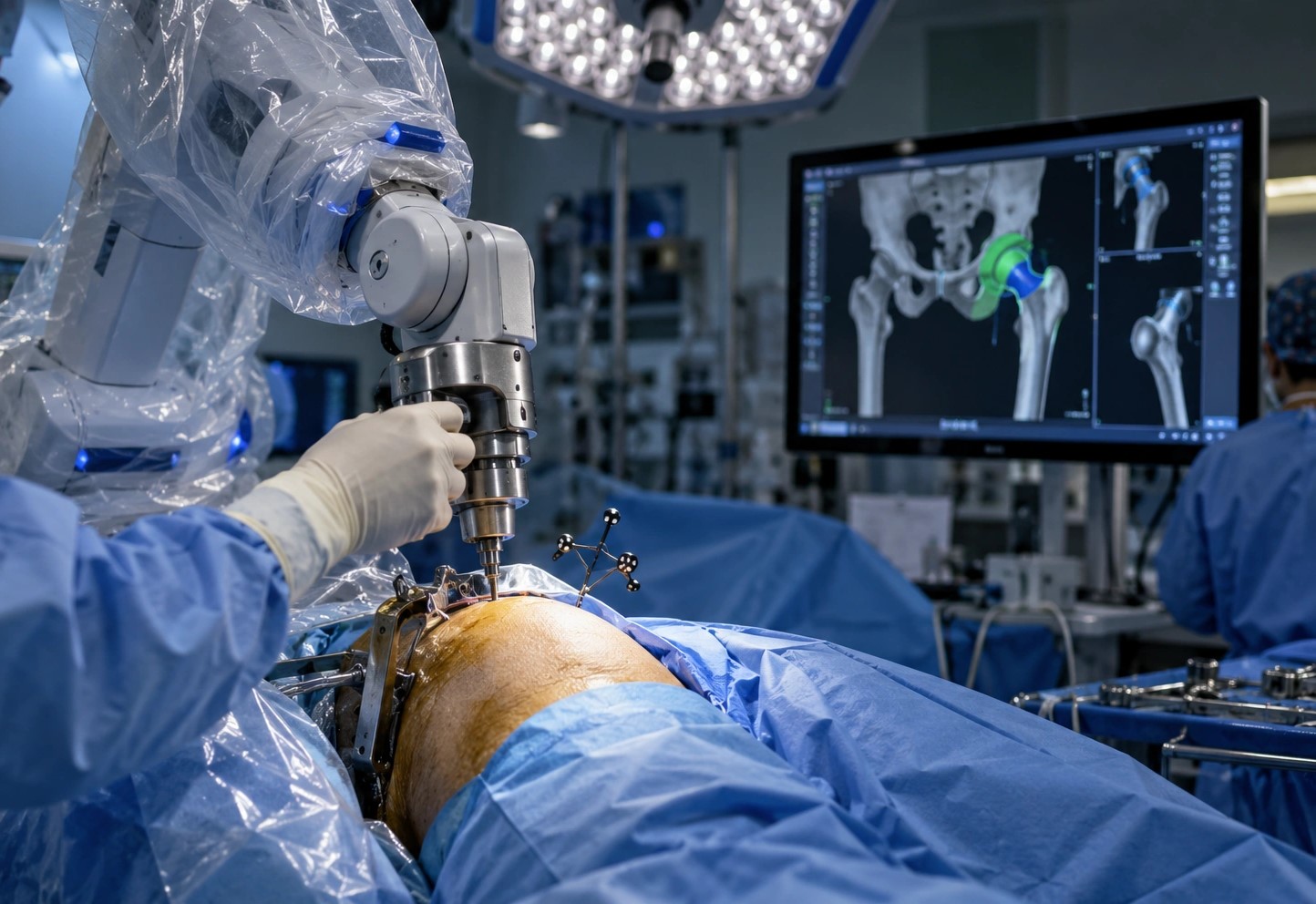
How the Robotic Hip Replacement Procedure Works
1
Pre-operative CT scan
A CT scan of your hip creates the 3D model Dr. Mishra uses to plan your surgery in advance.
2
Anaesthesia
The procedure is done under spinal or general anaesthesia, decided in consultation with the anaesthetist based on your health history.
3
Setting up the robotic system
Small bone tracker pins are placed so the robotic system can match your actual anatomy to the pre-operative plan in real time.
4
Bone preparation
The surgeon uses the robotic arm to remove damaged bone and cartilage strictly within the planned area. The system resists any movement outside that zone.
5
Implant placement
The stem, ball, and socket are placed at the exact angles worked out beforehand, checked in real time by the robotic system.
6
Closing up
The incision is closed in layers. Most patients are helped to stand and take a few steps within 24 hours.
Most robotic hip replacement surgeries take between 60 and 90 minutes, though this varies depending on the complexity of your case.
Cost of Robotic Hip Replacement Surgery in Delhi NCR
This is usually one of the first questions patients ask, so here's a realistic picture. Robotic hip replacement in Delhi NCR typically costs more than traditional hip replacement, mainly because of the additional robotic technology and imaging involved. Pricing depends on:
- The hospital and room category you choose
- The implant brand and material (ceramic vs. metal, for instance)
- Whether one or both hips need to be operated on
- Pre-surgery tests and any additional medical conditions that need managing
Because these factors vary so much from patient to patient, it's not something we can respond to accurately with a single number on a webpage. Contact ASIC Clinic for a personalised cost estimate after your consultation with Dr. Mishra.
Recovery After Robotic Hip Replacement
Recovery tends to be quicker than after traditional hip replacement, largely because there's less tissue trauma involved. Here's a general timeline most patients can expect:
| Time after surgery | What to expect |
|---|---|
| Within 24 hours | Standing and taking a few assisted steps |
| 2–3 days | Discharged from hospital |
| 4–6 weeks | Back to light daily activities |
| 6–8 weeks | Walking and swimming without much difficulty |
| 3–6 months | Full functional recovery, assuming physiotherapy is followed consistently |
Every patient heals at a different pace, so treat this as a general guide rather than a guarantee. Dr. Mishra's team puts together a physiotherapy-led recovery plan for each patient individually.

Frequently Asked Questions
Who is the best robotic hip replacement surgeon in Delhi NCR?
There are several experienced surgeons offering robotic hip replacement in Delhi NCR. Dr. Atul Mishra is one of them, with over 27+ years of experience and 1,000+ joint replacements performed annually. When choosing a surgeon, it's worth looking at their specific experience with robotic systems, not just their overall case count.
Is robotic hip replacement safer than traditional hip replacement?
Both are established, safe procedures. Robotic assistance adds a layer of precision to implant placement, which may reduce certain risks like dislocation and leg-length mismatch — but the surgeon's skill and experience remain the deciding factor either way.
How long does robotic hip replacement surgery take?
Most procedures take between 60 and 90 minutes, though this can vary based on the complexity of the case.
How soon can I walk after robotic hip replacement?
Most patients take a few assisted steps within 24 hours of surgery and are usually discharged within 2 to 3 days.
Does robotic hip replacement cost more than traditional surgery?
Yes, generally. The additional imaging and robotic technology add to the overall cost compared to traditional hip replacement. Exact pricing depends on the hospital, implant, and individual case, so it's best discussed directly with the clinic.
Is robotic hip replacement covered by insurance?
Coverage depends on your specific insurance policy and provider. We recommend checking directly with your insurer and our billing team before the procedure.
Book a Consultation with a Robotic Hip Replacement Surgeon in Delhi NCR
If hip pain has started affecting your daily life, the best next step is a proper clinical evaluation rather than more research. Book a consultation with Dr. Atul Mishra to find out whether robotic hip replacement is the right option for you.
Book an Appointment Call: +91 99582 20400