
Robotic Knee Replacement Surgeon in Delhi NCR – Dr. Atul Mishra
Medically reviewed by Dr. Atul Mishra, M.S. (Orthopaedics) · Last reviewed: 25 September 2026
Dr. Atul Mishra is a robotic knee replacement surgeon in Delhi NCR with 27+ years of experience in orthopaedics and joint replacement. He is the Director of ASIC Clinic, Preet Vihar, Delhi, and Chairman – Orthopedics & Joint Replacement at Fortis Hospital, Noida. He performs approximately 1,000–1,200 joint replacement surgeries every year and has completed more than 25,000 joint replacements. Robotic knee replacement is not the right choice for every patient: Dr. Mishra decides whether you are suitable only after a clinical examination, a review of your X-rays or other imaging, and a discussion of your symptoms, activity goals and overall health.
Dr. Atul Mishra at a Glance
| Speciality | Orthopaedics — knee and hip joint replacement (robotic, computer-navigated and conventional), revision joint replacement, arthroscopy and sports injuries |
| Experience | 27+ years |
| Qualifications | M.B.B.S. (1991), Ravindra Nath Tagore Medical College, Udaipur, University of Rajasthan · M.S. Orthopaedics (1998), N.H.L. Medical College & Seth K.M. School of Post Graduate Medical Research, Ahmedabad, Gujarat University |
| International fellowships | Fellowship in Joint Surgery (Mar–Apr 2005), Matsudo Municipal Hospital, National Chiba University Hospital and National Chiba Children's Hospital, Japan · Fellowship in Sports Medicine & Knee Surgery (Nov 2005–Jan 2006), Instituti Orthopedici Rizzoli, Bologna, Italy · Fellowship in Knee Reconstruction (Feb–Apr 2006), University Hospital, Philipps University Medical School, Marburg, Germany · Shoulder training, University of Arizona, USA |
| Current roles | Director, ASIC Clinic, Delhi · Chairman – Orthopedics & Joint Replacement, Fortis Hospital, Noida |
| Surgical volume | Approximately 1,000–1,200 joint replacement surgeries and 600 arthroscopic procedures per year · 25,000+ joint replacement surgeries in total |
| Consults at | ASIC Clinic, C-45, C Block, Preet Vihar, Delhi 110092 (Mon–Sat, 5:00–7:00 pm) · Fortis Hospital, Noida |
| Appointments | +91 99582 20400 · info@asicclinic.com |
Dr. Atul Mishra's Experience in Robotic Knee Replacement
Dr. Atul Mishra performs robotic knee replacement as part of a knee practice that spans more than 27 years. He carries out approximately 1,000–1,200 joint replacement surgeries a year, has completed over 25,000 joint replacements, and trained in knee reconstruction and knee surgery at leading centres in Germany, Italy and Japan before adding computer-assisted and robotic techniques to his practice.
His training abroad was knee-specific rather than general: a Fellowship in Knee Reconstruction at University Hospital, Philipps University Medical School, Marburg, Germany; a Fellowship in Sports Medicine & Knee Surgery at Instituti Orthopedici Rizzoli, Bologna, Italy; and a Fellowship in Joint Surgery at Matsudo Municipal Hospital and National Chiba University Hospital, Japan. That grounding in knee alignment, ligament balance and joint reconstruction is what robotic assistance builds on — the technology helps execute a plan, but the plan itself comes from surgical judgement.
Dr. Mishra offers the full range of knee replacement care, so the technique is chosen to fit the knee rather than the other way round:
- Robotic-assisted total knee replacement for advanced arthritis affecting the whole joint
- Partial (unicompartmental) knee replacement when arthritis is limited to one part of the knee
- Computer-navigated knee replacement
- Revision knee replacement when a previous knee replacement has failed
- Conventional total knee surgery with manual instruments, where that is the most appropriate option
What Is Robotic Knee Replacement Surgery?
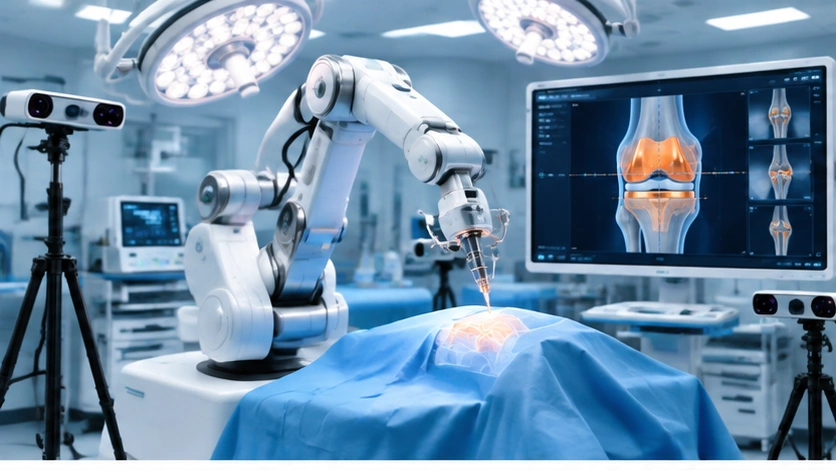
Robotic knee replacement is a knee replacement operation in which the orthopaedic surgeon uses a robotic-arm system to help plan and carry out the bone cuts and implant positioning. The surgeon makes every decision and performs the operation; the robot does not operate on its own. It is a way of assisting precision — not a different implant and not a different treatment for arthritis.
How Robotic Assistance Works
1
Digital planning
Depending on the robotic system, a 3D model of your knee is created from a pre-operative CT scan, or the knee's anatomy is mapped with a pointer during surgery. The surgeon uses this model to plan implant size, position and alignment.
2
Mapping and balance check
During the operation, the system tracks the thigh and shin bones and measures how tight or loose the ligaments are as the knee bends and straightens. The surgeon can fine-tune the plan based on these measurements.
3
Guided bone preparation
The robotic arm helps the surgeon remove bone according to the plan. On many systems, the arm keeps the cutting tool within the planned boundaries, reducing the chance of cutting beyond the intended area.
4
Implant placement and final check
Trial components are tested for movement and stability before the final implant is fixed in place.
The Surgeon's Role
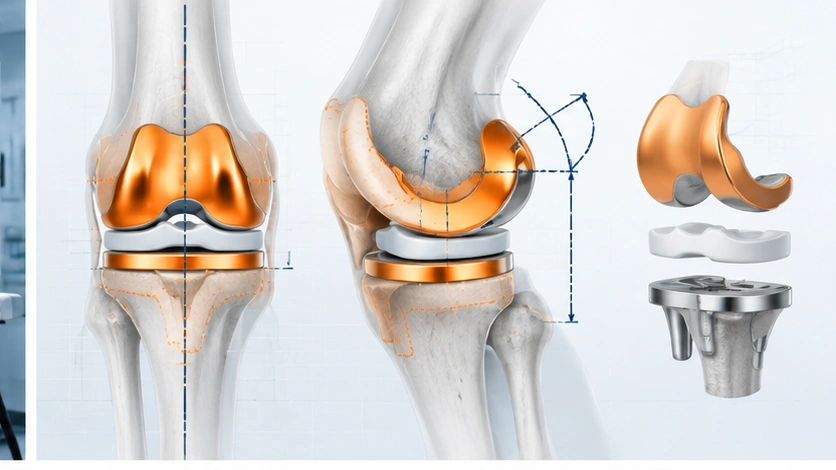
The robot does not perform the surgery independently. Dr. Atul Mishra decides whether robotic assistance is appropriate, approves and adjusts the surgical plan, makes the incision, controls the robotic arm, assesses stability and movement, and completes the operation. If needed, the surgeon can override the system or continue with conventional instruments. The implant used in robotic knee replacement is a standard knee replacement implant; the robot only helps position it.
Who May Need Robotic Knee Replacement?
Robotic knee replacement may be considered for adults with advanced knee arthritis whose pain and stiffness continue to limit daily life despite appropriate non-surgical treatment. The decision is based on symptoms, examination findings and X-rays together — not on age or imaging alone. Whether the robotic technique is used is then decided separately, case by case.
Signs You May Be a Candidate
- Advanced osteoarthritis — loss of joint space ("bone-on-bone") on standing X-rays
- Knee pain that persists at rest or at night, or limits walking, climbing stairs or getting up from a chair
- Stiffness and reduced range of motion that interfere with daily activities
- Visible deformity, such as bow-legs (varus) or knock-knees (valgus)
- Arthritis from other causes, such as rheumatoid arthritis or an old knee injury (post-traumatic arthritis)
- Little or no lasting relief after an adequate trial of physiotherapy, weight management, medicines, injections or bracing
When Knee Replacement May Not Be Necessary
Many people with knee pain do not need surgery — robotic or otherwise. Dr. Mishra usually advises against surgery, or recommends waiting, when:
- arthritis is early or moderate and symptoms are controlled with non-surgical care
- the pain comes from another source, such as a meniscus or ligament injury, or is referred from the hip or spine
- there is an active infection, or a medical condition that must be brought under control first
- the patient's goals can be met with a less invasive treatment
In these situations, options may include structured physiotherapy, weight management, medicines, injections, arthroscopic surgery for specific mechanical problems or cartilage cell therapy where appropriate.
How Dr. Atul Mishra Plans Robotic Knee Replacement
Dr. Atul Mishra plans every robotic knee replacement around the individual knee. A detailed consultation, imaging, a medical fitness check and a personalised surgical plan come before the operation, and a structured rehabilitation programme follows it. Each step below shapes whether robotic assistance is used and how the procedure is carried out.
1
Consultation and examination at ASIC Clinic
Dr. Mishra reviews your symptoms, previous treatment, medical history and activity goals, and examines the knee's alignment, movement and ligament stability, along with the hip and spine.
2
Imaging
Standing X-rays of the knee are the starting point. A CT scan is added when the robotic system requires CT-based planning, and an MRI only when another problem needs to be ruled out.
3
Discussion of options
Non-surgical treatment, partial versus total knee replacement, and robotic, computer-navigated or conventional techniques are discussed, including the benefits, limitations, risks and costs of each.
4
Pre-operative fitness assessment
Blood tests, cardiac evaluation and, where relevant, control of diabetes, blood pressure or other conditions, in coordination with physicians and the anaesthesia team.
5
Individualised surgical plan
Implant size, alignment, bone resection and soft-tissue balance are planned for your knee's anatomy and refined during surgery using the robotic system's measurements.
6
Robotic-assisted surgery at Fortis Hospital, Noida
The operation is usually performed under spinal or regional anaesthesia. Dr. Mishra maps the knee, confirms the plan, prepares the bone with robotic guidance and checks movement and stability with trial components before fixing the final implant.
7
Early mobilisation and rehabilitation
Most patients begin standing and walking with support within about 24 hours, with physiotherapy continuing in hospital and at home.
8
Follow-up
Review visits track wound healing, knee bend, strength and walking until recovery is complete.
Robotic vs Conventional Knee Replacement: What Is the Difference?
Both robotic and conventional knee replacement use the same kind of implant and are performed by the surgeon. The difference lies in how the operation is planned and guided: robotic assistance adds a patient-specific digital plan and real-time measurement, while conventional surgery relies on mechanical alignment guides and the surgeon's assessment. Neither approach is right for every patient.
| Aspect | Robotic-assisted knee replacement | Conventional knee replacement |
|---|---|---|
| Planning | Patient-specific digital plan before bone cuts, adjustable during surgery | Based on X-rays, templating and the surgeon's assessment during surgery |
| Surgical guidance | Real-time tracking; robotic arm guides the cutting tool within planned boundaries | Mechanical cutting jigs and alignment guides |
| Implant positioning | Published studies report more consistent alignment relative to the plan | Accurate in experienced hands; relies more on instruments and surgical judgement |
| Ligament balance | Measured with data during surgery | Assessed by feel and spacer blocks |
| Surgeon control | Surgeon controls every step and can override the system | Surgeon controls every step |
| Imaging | CT scan may be needed, depending on the system | Usually standard X-rays |
| Operating time | Set-up may add time | Typically shorter set-up |
| Cost | Generally higher | Generally lower |
| Patient suitability | Most primary cases, decided case by case | Suitable for nearly all cases |
Research consistently shows that robotic assistance can place implants closer to the planned position. Whether this translates into better long-term pain relief, function or implant survival than well-performed conventional surgery is still being studied. Dr. Mishra discusses both approaches openly so that the choice is based on your knee, not on the technology.
Potential Benefits and Limitations of Robotic Knee Replacement
Robotic knee replacement offers potential advantages in planning and precision, but it also has limitations. It is a tool that can support good surgery — it does not replace surgical experience, and recovery still depends on your health, the condition of your knee and your commitment to rehabilitation.
Potential Benefits
- Bone cuts guided by a plan made for your knee's anatomy
- More consistent implant alignment relative to the plan, as reported in published studies
- Measured ligament-balance data during surgery rather than assessment by feel alone
- May help limit disturbance to surrounding soft tissue, which some studies link with less early pain — findings vary
- A detailed record of how the implant was positioned
Limitations
- Higher cost than conventional surgery
- A CT scan, with its radiation dose, may be needed depending on the system
- Longer set-up and, in some cases, operating time
- Small additional incisions or pins for tracking arrays on some systems
- Long-term advantages in function and implant survival are not yet proven over conventional surgery
- Not every knee, and not every patient, needs robotic assistance
Why Patients Consult Dr. Atul Mishra for Robotic Knee Replacement in Delhi NCR
Patients looking for the best robotic knee replacement surgeon in Delhi usually compare surgeons on experience, surgical volume, training, the range of knee procedures offered and ease of access. These are measurable factors, and they are the basis of Dr. Atul Mishra's practice at ASIC Clinic and Fortis Hospital, Noida.
- 27+ years of experience — in orthopaedics and joint replacement surgery.
- High surgical volume — approximately 1,000–1,200 joint replacements a year and 25,000+ joint replacements in total.
- Knee-focused international training — fellowships in Germany (knee reconstruction), Italy (sports medicine & knee surgery) and Japan (joint surgery).
- Robotic and computer-assisted techniques — alongside conventional surgery, with the approach matched to each knee.
- The full range of knee replacement — total, partial and revision knee replacement under one surgeon.
- Senior clinical leadership — Chairman – Orthopedics & Joint Replacement at Fortis Hospital, Noida, and Director of ASIC Clinic.
- Accessible across Delhi NCR — consultations at ASIC Clinic, Preet Vihar (East Delhi), and at Fortis Hospital, Noida, within reach of Ghaziabad, Greater Noida and central Delhi.
Labels such as "top robotic knee replacement surgeon in Delhi NCR" are best tested against facts. Whichever surgeon you consult, it is reasonable to ask how many of these operations they perform each year, which techniques they offer, why they recommend a particular approach for you and what the recovery plan involves.
Recovery After Robotic Knee Replacement
Most patients walk with support within a day of robotic knee replacement, manage daily activities at home in about six weeks and continue improving for up to a year. Recovery is different for every patient: age, general health, the condition of the knee before surgery and regular physiotherapy all affect the pace.
| Phase | What typically happens |
|---|---|
| First 24–48 hours | Standing and walking with a walker under physiotherapy supervision; pain control, cold therapy and measures to prevent blood clots; simple knee-bending and muscle exercises |
| Hospital stay | Discharge usually after a few days, once you can walk safely, use the toilet independently and manage steps |
| Weeks 1–2 | Walking with a walker at home; daily exercises to improve bending and straightening; wound check and removal of sutures or staples at around two weeks |
| Weeks 3–6 | Most patients progress to a stick and then to walking independently; bend and strength improve; desk-based work and driving often resume around four to six weeks, once your surgeon clears you |
| Weeks 6–12 | Longer walks, stairs and most routine activities become easier; swelling gradually settles |
| 3–12 months | Strength, stamina and comfort keep improving; mild swelling or warmth can persist for months; low-impact activities such as walking, swimming and cycling are generally encouraged |
Dr. Mishra and the physiotherapy team adjust the programme to your progress. These milestones are a guide, not a guarantee.
Risks and Possible Complications of Robotic Knee Replacement
Robotic knee replacement is a major operation and carries the same recognised risks as any knee replacement, along with a few related to the robotic technology. Serious complications are uncommon, but no surgery is risk-free. Dr. Mishra discusses your individual risk profile before you decide on surgery.
Risks of Knee Replacement Surgery
- Infection of the wound or, rarely, of the joint
- Blood clots in the leg veins (deep vein thrombosis) that can travel to the lungs (pulmonary embolism)
- Knee stiffness or reduced range of movement
- Persistent pain or dissatisfaction despite a well-positioned implant
- Bleeding, wound-healing problems or injury to nearby nerves or blood vessels
- Instability, implant loosening or wear over time, which may eventually need revision surgery
- Fracture of the bone around the implant
- Risks related to anaesthesia and existing medical conditions
Risks Specific to Robotic Assistance
- Pain, infection or, rarely, fracture at the tracking-pin sites, on systems that use pins
- Longer operating or anaesthesia time in some cases
- Technical issues with the system, in which case the surgeon completes the operation with conventional instruments
When to seek urgent medical advice: Contact your surgical team or seek emergency care if you notice fever, increasing redness, warmth or discharge from the wound, new calf pain or swelling, chest pain or breathlessness.
Frequently Asked Questions About Robotic Knee Replacement in Delhi
Who is a robotic knee replacement surgeon in Delhi?
A robotic knee replacement surgeon is an orthopaedic surgeon who performs knee replacement using a robotic-arm system for planning and guidance. In Delhi NCR, Dr. Atul Mishra — Director of ASIC Clinic, Preet Vihar, and Chairman – Orthopedics & Joint Replacement at Fortis Hospital, Noida — performs robotic knee replacement, with 27+ years of experience and more than 25,000 joint replacements.
How do I choose the best robotic knee replacement surgeon in Delhi NCR?
Look at verifiable factors: years of experience, the number of knee and joint replacements performed each year, specialised knee training, whether robotic, computer-navigated and conventional options are all offered, and how clearly the surgeon explains your suitability, risks and recovery. A good surgeon will also tell you when robotic surgery — or any surgery — is not needed.
Does Dr. Atul Mishra perform robotic knee replacement?
Yes. Dr. Atul Mishra performs robotic-assisted knee replacement in Delhi NCR. He also performs computer-navigated, conventional, partial and revision knee replacement, and recommends the technique that best suits each patient after a clinical evaluation.
Where does Dr. Atul Mishra consult for robotic knee replacement?
Dr. Atul Mishra consults at ASIC Clinic, C-45, C Block, Preet Vihar, Delhi 110092 (Monday to Saturday, 5:00–7:00 pm), and at Fortis Hospital, Noida, where he is Chairman – Orthopedics & Joint Replacement. Robotic knee replacement surgery is performed at Fortis Hospital, Noida. Appointments: +91 99582 20400.
How much knee replacement experience does Dr. Atul Mishra have?
Dr. Atul Mishra has 27+ years of experience in orthopaedics and joint replacement. He performs approximately 1,000–1,200 joint replacement surgeries a year, has completed more than 25,000 joint replacements, and holds international fellowships in knee reconstruction (Germany), sports medicine and knee surgery (Italy) and joint surgery (Japan).
Is robotic knee replacement better than conventional knee replacement?
Not automatically. Robotic knee replacement can improve the accuracy and consistency of implant positioning relative to the plan, but long-term advantages in function and implant survival over well-performed conventional surgery are still being studied. The better option is the one that suits your knee, general health and goals, as assessed by your surgeon.
Who is suitable for robotic knee replacement?
Most adults who need a primary knee replacement for advanced arthritis may be suitable, provided they are medically fit for surgery. Suitability depends on the severity of arthritis, knee deformity, bone quality, previous surgery and overall health. Dr. Mishra confirms suitability only after an examination and a review of imaging.
How long does recovery take after robotic knee replacement?
Most patients walk with support within 24 hours, return to many daily activities in about six weeks and continue to improve for up to 12 months. Recovery varies with age, general health, the condition of the knee before surgery and commitment to physiotherapy.
Is robotic knee replacement safe?
Robotic knee replacement is an established procedure with a safety profile similar to conventional surgery when performed by an experienced surgical team. Like any major surgery, it carries risks such as infection, blood clots, stiffness and, on some systems, pin-site problems. Your surgeon should explain your individual risks before surgery.
What is the difference between robotic and computer-navigated knee replacement?
Computer navigation tracks the knee and shows the surgeon real-time alignment data, but the bone cuts are made with conventional cutting guides. Robotic systems use similar tracking and planning and add a robotic arm that guides or limits the cutting tool to the planned boundaries. Dr. Atul Mishra offers both techniques.
Book a Robotic Knee Replacement Consultation with Dr. Atul Mishra
About the reviewer
- Medically reviewed by Dr. Atul Mishra
- M.B.B.S. (1991), University of Rajasthan · M.S. Orthopaedics (1998), Gujarat University
- Director, ASIC Clinic · Chairman – Orthopedics & Joint Replacement, Fortis Hospital, Noida
- 27+ years of experience · 25,000+ joint replacement surgeries
- Last medically reviewed: 25 September 2026
If knee pain is limiting your walking, sleep or daily activities, a consultation will clarify whether you need treatment, which type, and whether robotic knee replacement is appropriate for you. Please bring your recent X-rays, MRI or CT reports and a list of your current medicines.
- ASIC Clinic (Arthroplasty & Sports Injury Centre), C-45, C Block, Preet Vihar, Delhi 110092
- Consultation hours: Monday–Saturday, 5:00–7:00 pm · Sunday closed
- Phone: +91 99582 20400 · Email: info@asicclinic.com
This page is for general information and does not replace a personal medical consultation. Suitability, risks and outcomes differ between patients.
Book Your Robotic Knee Replacement Consultation
A consultation will clarify whether you need treatment, which technique is right, and what your recovery would look like.
Book an Appointment Call: +91 99582 20400