
Robotic Joint Replacement Surgeon in Delhi NCR – Dr. Atul Mishra
Medically reviewed by Dr. Atul Mishra, M.S. (Orthopaedics) · Last reviewed: 25 September 2026
Dr. Atul Mishra is a robotic joint replacement surgeon in Delhi NCR who treats advanced knee and hip arthritis using robotic-assisted, computer-navigated and conventional techniques. With 27+ years of experience and more than 25,000 joint replacements, he currently performs approximately 1,000–1,200 joint replacement surgeries a year. He is the Director of ASIC Clinic, Preet Vihar, Delhi, and Chairman – Orthopedics & Joint Replacement at Fortis Hospital, Noida. Robotic joint replacement is one option within his practice, not a default: each patient's joint, health and goals decide whether surgery is needed and which technique is used.
Dr. Atul Mishra at a Glance
| Speciality | Orthopaedics — knee and hip joint replacement (robotic, computer-navigated and conventional), revision joint replacement, arthroscopy and sports injuries |
| Experience | 27+ years |
| Qualifications | M.B.B.S. (1991), Ravindra Nath Tagore Medical College, Udaipur, University of Rajasthan · M.S. Orthopaedics (1998), N.H.L. Medical College & Seth K.M. School of Post Graduate Medical Research, Ahmedabad, Gujarat University |
| International fellowships | Fellowship in Joint Surgery (Mar–Apr 2005), Matsudo Municipal Hospital, National Chiba University Hospital and National Chiba Children's Hospital, Japan · Fellowship in Sports Medicine & Knee Surgery (Nov 2005–Jan 2006), Instituti Orthopedici Rizzoli, Bologna, Italy · Fellowship in Knee Reconstruction (Feb–Apr 2006), University Hospital, Philipps University Medical School, Marburg, Germany · Shoulder training, University of Arizona, USA |
| Current roles | Director, ASIC Clinic, Delhi · Chairman – Orthopedics & Joint Replacement, Fortis Hospital, Noida |
| Surgical volume | Approximately 1,000–1,200 joint replacement surgeries and 600 arthroscopic procedures per year · 25,000+ joint replacement surgeries in total |
| Consults at | ASIC Clinic, C-45, C Block, Preet Vihar, Delhi 110092 (Mon–Sat, 5:00–7:00 pm) · Fortis Hospital, Noida |
| Appointments | +91 99582 20400 · info@asicclinic.com |
Dr. Atul Mishra's Experience in Robotic Joint Replacement
Dr. Atul Mishra's experience in robotic joint replacement rests on a high-volume knee and hip replacement practice. Across 27+ years he has completed more than 25,000 joint replacements — covering primary, partial and revision knee replacement and hip replacement — and he uses robotic and computer-assisted technology where it adds value to a particular operation.
His international training covers the joints most often involved in replacement surgery: joint surgery in Japan (Matsudo Municipal Hospital, National Chiba University Hospital and National Chiba Children's Hospital), sports medicine and knee surgery at Instituti Orthopedici Rizzoli in Bologna, Italy, and knee reconstruction at Philipps University Medical School in Marburg, Germany, along with shoulder training at the University of Arizona, USA.
Because he performs conventional, computer-navigated and robotic procedures, Dr. Mishra can compare approaches from direct experience rather than recommending one technology for every case. Complex situations — severe deformity, previous joint surgery or a failed implant — are assessed individually, and revision surgery is part of his practice.
What Is Robotic Joint Replacement?
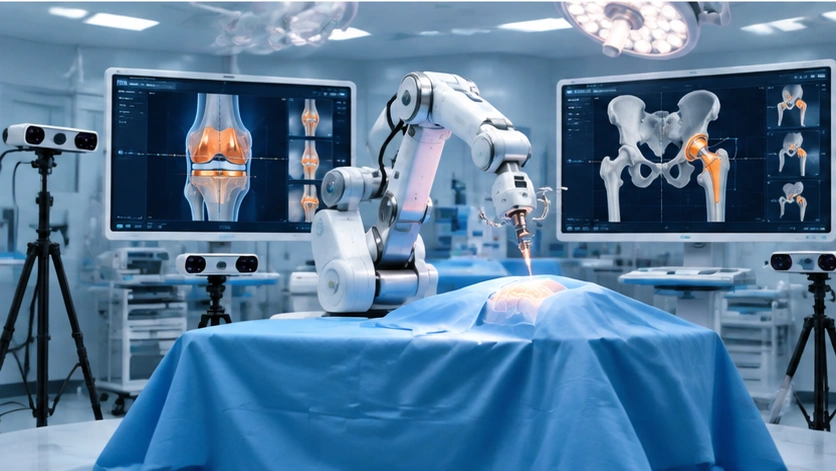
Robotic joint replacement is joint replacement surgery — most commonly of the knee or hip — in which the orthopaedic surgeon uses a robotic-arm system to plan the operation in detail and to guide bone preparation and implant positioning. The surgeon remains in control throughout; the robotic system provides measurement, planning and guidance but does not operate on its own.
Three Things the Technology Adds
1
A patient-specific plan
The joint is modelled digitally, from a CT scan or from mapping during surgery depending on the system, so implant size and position can be planned for that patient's anatomy.
2
Real-time feedback
Tracking shows the surgeon exactly where the bones and instruments are at every stage of the operation.
3
Guided execution
The robotic arm helps the surgeon prepare bone and position components according to the plan, and can limit movement beyond planned boundaries.
What Stays the Same
The implant is a standard knee or hip replacement implant, the operation still needs an incision, and recovery still depends on rehabilitation. The key decisions — whether to operate, what to plan and when to change the plan — are made by the surgeon, not the machine.
Robotic Joint Replacement Procedures Offered by Dr. Atul Mishra
Dr. Atul Mishra performs robotic joint replacement for the knee and the hip. Each joint has different planning goals — alignment and ligament balance in the knee, socket position and leg length in the hip — and each procedure has a dedicated page with detailed information on suitability, surgery and recovery.
Robotic Knee Replacement
Used for advanced knee arthritis, robotic knee replacement helps the surgeon plan bone cuts, restore alignment and balance the ligaments around the new knee. It is most often used for total knee replacement.
Robotic knee replacement with Dr. Atul MishraRobotic Hip Replacement
In hip replacement, robotic assistance helps the surgeon plan and position the socket (cup) and stem — factors linked to hip stability and leg length. It may be considered for hip arthritis, avascular necrosis and other conditions that have damaged the hip joint.
Robotic hip replacement with Dr. Atul Mishra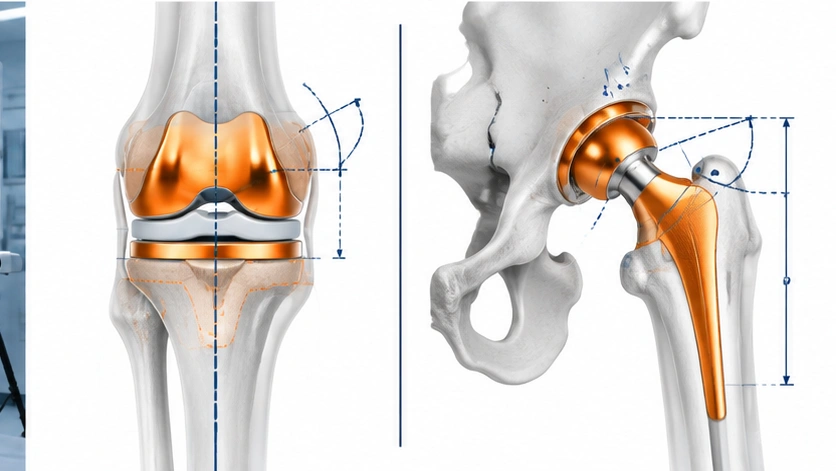
Conditions That May Require Joint Replacement
Replacement surgery is considered when a knee or hip joint is so damaged that pain and loss of function persist despite appropriate treatment. The most common reasons are listed below. In every case, the diagnosis is confirmed by clinical examination and imaging before surgery is discussed.
- Knee osteoarthritis — wear of the cartilage in one or more parts of the knee, often with bow-leg or knock-knee deformity.
- Hip osteoarthritis — cartilage loss in the hip causing groin or thigh pain, stiffness and a limp.
- Inflammatory arthritis — such as rheumatoid arthritis, which can damage several joints.
- Avascular necrosis (AVN) of the hip — loss of blood supply to the head of the thigh bone, which can lead to collapse of the joint in advanced stages.
- Post-traumatic arthritis — arthritis that develops after a fracture or serious injury to the joint.
- Severe joint degeneration or deformity — where the structure of the joint is badly damaged.
- Failed previous joint replacement — loosening, infection, instability or wear of an earlier implant, which may need revision knee replacement or revision hip surgery.
Who May Be a Candidate for Robotic Joint Replacement?
You may be a candidate for robotic joint replacement if advanced arthritis or joint damage in your knee or hip causes persistent pain and disability, imaging confirms significant damage, and appropriate non-surgical treatment has not helped enough. Surgery is not automatically recommended — many patients do well with conservative care.
Symptoms That May Point Towards Surgery
- Persistent pain in the knee, hip, groin or thigh, including at night
- Difficulty walking, climbing stairs, squatting, sitting cross-legged or getting in and out of a car
- Stiffness, a limp or reduced range of movement
- Dependence on painkillers for everyday activities
What Confirms Candidacy
Dr. Mishra combines a clinical examination with X-rays — and CT or MRI where required — to judge the extent of joint damage. He also considers general health, bone quality, previous surgery and your goals. Whether robotic assistance is used is decided only after this evaluation.
When Surgery Is Not the First Step
For early or moderate arthritis, treatment usually begins with physiotherapy, weight management, activity changes, medicines and, in selected cases, injections. Surgery is discussed when these measures no longer give adequate relief.
How Dr. Atul Mishra Evaluates and Plans Treatment
Dr. Atul Mishra's approach moves in order: he first confirms the cause of pain, then decides whether surgery is needed, then chooses the most suitable technique — conventional, computer-navigated or robotic — and finally plans surgery and rehabilitation around the individual patient.
1
Consultation
History, symptoms, previous treatment and what you want to be able to do again.
2
Diagnosis
Examination of the affected joint, with assessment of the spine and neighbouring joints to rule out referred pain.
3
Imaging
X-rays, with CT or MRI where needed for diagnosis or robotic planning.
4
Choice of approach
Conventional, computer-navigated or robotic technique, chosen on the basis of the joint involved, anatomy, deformity, bone quality, previous surgery and the evidence for each technique in that situation.
5
Medical optimisation
Fitness checks and control of conditions such as diabetes or high blood pressure before surgery.
6
Individualised surgical plan
Implant type, size and position planned for the patient's anatomy.
7
Surgery at Fortis Hospital, Noida
Performed by Dr. Mishra with the anaesthesia, nursing and physiotherapy team.
8
Rehabilitation and follow-up
Early mobilisation, a joint-specific physiotherapy programme and scheduled review visits.
Robotic vs Conventional Joint Replacement
Robotic and conventional techniques share the same goal and use comparable implants. Robotic surgery adds a digital plan, real-time tracking and guided bone preparation; conventional surgery relies on instruments, templates and the surgeon's judgement during the operation. Both are established approaches, and the right choice depends on the patient.
| Factor | Robotic joint replacement | Conventional joint replacement |
|---|---|---|
| Pre-operative planning | Digital, patient-specific plan (CT-based or image-free, depending on the system) | X-ray templating and clinical assessment |
| Guidance during surgery | Real-time tracking and robotic-arm guidance | Mechanical guides and the surgeon's visual and tactile assessment |
| Surgeon control | Surgeon plans, controls and can override the system at any time | Surgeon performs every step manually |
| Knee focus | Alignment and ligament balance measured during surgery | Alignment set with jigs; balance assessed by feel and spacers |
| Hip focus | Planned cup angle, stem position and leg length | Positioning guided by anatomical landmarks and instruments |
| Applicability | Most primary knee and hip replacements, where the system suits the case | Almost all primary and revision cases |
| Limitations | Higher cost; possible CT scan; set-up time; not suitable for every case | Greater reliance on manual instruments for accuracy |
Potential Benefits and Limitations of Robotic Joint Replacement
The main potential benefit of robotic joint replacement is greater consistency in achieving the planned implant position. The main limitations are cost, extra imaging and set-up, and the fact that long-term outcome advantages over well-performed conventional surgery are not yet firmly established. Rehabilitation remains essential either way.
Potential Benefits
- Reproducible implant positioning based on a patient-specific plan
- In the knee: measured ligament-balance data during surgery
- In the hip: planned cup orientation and leg-length restoration
- May help in some joints with unusual anatomy or deformity
- A detailed record of how implants were positioned
Limitations
- Higher cost than conventional surgery
- A CT scan, with its radiation dose, may be needed depending on the system
- Additional set-up time and, on some systems, pin sites for trackers
- Not available or appropriate for every case, including some revision operations
- Long-term evidence on function and implant survival is still evolving
- Recovery still depends on your health and on rehabilitation
Why Patients Consult Dr. Atul Mishra for Robotic Joint Replacement in Delhi NCR
When patients search for the best robotic joint replacement surgeon in Delhi, the most useful comparison is based on evidence: experience, surgical volume, training, the range of joints and techniques covered, and practical access to care. On each of these points, Dr. Atul Mishra's practice can be checked against verifiable facts.
- Knee and hip replacement expertise — primary, partial and revision procedures within one practice.
- Experience measured in decades — 27+ years in orthopaedics and joint replacement.
- Volume that builds judgement — approximately 1,000–1,200 joint replacements every year; 25,000+ overall.
- Training across three continents — fellowships in Japan, Italy and Germany, plus shoulder training in the USA.
- Technique choice, not technique bias — robotic, computer-navigated and conventional options.
- Leadership responsibility — Chairman – Orthopedics & Joint Replacement, Fortis Hospital, Noida; Director, ASIC Clinic.
- Two Delhi NCR locations — Preet Vihar in East Delhi and Fortis Hospital, Noida, within reach of Ghaziabad, Greater Noida and central Delhi.
Whether you are comparing a top robotic joint replacement surgeon in Delhi NCR or seeking a second opinion, it helps to ask each surgeon about their annual volume, the techniques they use, how they decide who needs robotic surgery and what their rehabilitation plan involves.
Recovery and Rehabilitation After Robotic Joint Replacement
Recovery after robotic joint replacement depends on which joint is replaced and on the individual patient. Most knee and hip patients stand and walk with support within about a day of surgery, but the exercises, precautions and timelines differ between the two joints, so each has its own rehabilitation plan.
| Robotic knee replacement | Robotic hip replacement | |
|---|---|---|
| Walking with support | Usually within 24 hours | Usually within 24 hours |
| Main rehabilitation focus | Regaining knee bend and straightening; thigh-muscle strength | Hip strength, balance and walking pattern; any precautions advised for the surgical approach |
| Walking aids | Walker, then a stick, over the first few weeks | Walker or crutches, then a stick, over the first few weeks |
| Many daily activities | Around six weeks for many patients | Around six weeks for many patients |
| Continued improvement | Up to 12 months | Up to 12 months |
These are typical patterns, not guarantees. For step-by-step detail, see recovery after robotic knee replacement and the robotic hip replacement page.
Rehabilitation Principles Common to Both Joints
- Early, supervised mobilisation with the physiotherapy team
- Daily home exercises, progressed as strength and movement improve
- Blood-clot prevention measures as advised by your surgeon
- Wound care and scheduled follow-up visits
- A gradual return to driving, work and low-impact activity once cleared by your surgeon
Risks and Possible Complications of Robotic Joint Replacement
Robotic joint replacement carries the recognised risks of any knee or hip replacement operation. The level of risk varies with the joint being replaced, age, general health and other individual factors. Serious complications are uncommon, and Dr. Mishra explains your personal risks before any decision about surgery is made.
Risks Common to Knee and Hip Replacement
- Infection of the wound or, rarely, of the joint
- Blood clots in the leg veins, which can travel to the lungs
- Bleeding, wound-healing problems or injury to nearby nerves or blood vessels
- Implant loosening or wear over time, which may need revision surgery
- Fracture of the bone around the implant
- Persistent pain
- Risks related to anaesthesia and existing medical conditions
Joint-Specific Risks
- Knee: stiffness, reduced range of movement or instability
- Hip: dislocation, a difference in leg length or a change in walking pattern
Technology-Related Risks
- Pain, infection or, rarely, fracture at tracking-pin sites, on systems that use pins
- Longer operating time in some cases
- System issues, in which case the surgeon completes the operation conventionally
When to seek urgent medical advice: Seek urgent medical advice after surgery if you develop fever, spreading redness or discharge from the wound, calf pain or swelling, chest pain, breathlessness, or sudden severe pain with inability to move the joint.
Frequently Asked Questions About Robotic Joint Replacement in Delhi
Who is a robotic joint replacement surgeon in Delhi?
A robotic joint replacement surgeon is an orthopaedic surgeon trained to perform knee or hip replacement with the help of a robotic-arm system. Dr. Atul Mishra is a robotic joint replacement surgeon in Delhi NCR, consulting at ASIC Clinic, Preet Vihar, and Fortis Hospital, Noida, with 27+ years of experience and more than 25,000 joint replacements.
How do I choose a robotic joint replacement surgeon in Delhi NCR?
Compare surgeons on facts you can verify: years of experience in knee and hip replacement, annual surgical volume, specialised training, the joints and techniques they offer, and how clearly they explain whether you need surgery at all. Ask why a particular approach — robotic, computer-navigated or conventional — is being recommended for your joint.
Does Dr. Atul Mishra perform robotic joint replacement?
Yes. Dr. Atul Mishra performs robotic-assisted knee and hip replacement. He also performs computer-navigated and conventional joint replacement, partial knee replacement and revision surgery, and chooses the technique after evaluating each patient.
Which joints can be treated with robotic-assisted joint replacement?
Robotic-assisted joint replacement is most commonly used for the knee and the hip. At ASIC Clinic, Dr. Atul Mishra offers robotic knee replacement and robotic hip replacement. Suitability depends on the joint, the extent of damage and the patient's overall health.
What is the difference between robotic and conventional joint replacement?
In robotic joint replacement, the surgeon uses a digital plan, real-time tracking and a robotic arm to guide bone preparation and implant positioning. Conventional joint replacement uses mechanical instruments and the surgeon's judgement. Both are performed by the surgeon with comparable implants; robotic assistance mainly adds planning detail and positioning consistency.
Is robotic joint replacement suitable for everyone?
No. Some patients do not need surgery at all, and some are better treated with conventional or computer-navigated techniques because of their anatomy, previous surgery or certain revision situations. Suitability for robotic joint replacement is decided only after a clinical examination and imaging.
Where does Dr. Atul Mishra consult?
Dr. Atul Mishra consults at ASIC Clinic, C-45, C Block, Preet Vihar, Delhi 110092, Monday to Saturday from 5:00 to 7:00 pm, and at Fortis Hospital, Noida, where he is Chairman – Orthopedics & Joint Replacement. Appointments can be booked on +91 99582 20400 or at info@asicclinic.com.
How much joint replacement experience does Dr. Atul Mishra have?
Dr. Atul Mishra has 27+ years of experience and has performed more than 25,000 joint replacement surgeries. He currently performs approximately 1,000–1,200 joint replacements and 600 arthroscopic procedures a year, and trained through international fellowships in Japan, Italy and Germany.
How long is recovery after robotic joint replacement?
Most patients walk with support within about a day and resume many daily activities in around six weeks, with continued improvement for up to a year. Recovery differs between knee and hip replacement and from patient to patient, depending on age, general health and rehabilitation.
Does the robot perform the surgery?
No. The robot does not operate independently. Dr. Atul Mishra plans the procedure, controls the robotic arm and makes every surgical decision. The system provides measurements and guidance that help the surgeon carry out the plan accurately.
Book a Robotic Joint Replacement Consultation with Dr. Atul Mishra
About the reviewer
- Medically reviewed by Dr. Atul Mishra
- M.B.B.S. (1991), University of Rajasthan · M.S. Orthopaedics (1998), Gujarat University
- Director, ASIC Clinic · Chairman – Orthopedics & Joint Replacement, Fortis Hospital, Noida
- 27+ years of experience · 25,000+ joint replacement surgeries
- Last medically reviewed: 25 September 2026
If knee or hip pain is limiting your daily life, a consultation with Dr. Mishra will establish the cause, whether surgery is needed and, if it is, whether robotic joint replacement is the right approach for you. Please bring recent X-rays, any MRI or CT reports and a list of your current medicines.
- ASIC Clinic (Arthroplasty & Sports Injury Centre), C-45, C Block, Preet Vihar, Delhi 110092
- Consultation hours: Monday–Saturday, 5:00–7:00 pm · Sunday closed
- Phone: +91 99582 20400 · Email: info@asicclinic.com
This page is for general information and does not replace a personal medical consultation. Suitability, risks and outcomes differ between patients.
Book Your Robotic Joint Replacement Consultation
A consultation will clarify the cause of your joint pain, whether surgery is needed, and which technique is right for you.
Book an Appointment Call: +91 99582 20400